Sustainable & Recycled Textiles for Autumn Lines
Sustainable textiles for autumn lines should be selected around garment performance, verified material content and the needs of Australian customers—not environmental labels alone. This article explores how to assess recycled fabrics and natural fibers, plan useful seasonal layers, and communicate material choices clearly. For brands preparing a sourcing brief for ZIYANG B2B activewear manufacturer, these principles offer a practical starting point without assuming any particular fabric availability or certification.
What makes a textile a better choice for an autumn collection?
A better textile is one that meets the garment’s intended use while offering specific, substantiated improvements rather than a vague sustainability promise. Assess its composition, sourcing evidence, manufacturing requirements, expected durability and realistic end-of-life options together. The European Environment Agency identifies longer use, reuse and recycling among the ways to reduce textiles’ environmental impacts; changing the fibre alone is not the whole solution. (eea.europa.eu)
Start with the product brief. A fitted training legging, relaxed sweatshirt and lightweight overshirt should not automatically share the same fabric specification. Define the movement, coverage, warmth and care requirements before comparing material options.
Use three questions to keep decisions grounded:
- What must this garment do? Set priorities such as stretch recovery, comfortable layering or resistance to visible wear.
- What improvement can be demonstrated? Request evidence for recycled content, sourcing claims or other stated attributes.
- What trade-off needs explaining? Record any compromise involving care, construction, performance or recovery after use.
This approach gives sustainable fashion a practical meaning: make a useful product, understand its limitations and describe it honestly.
Plan for Australian autumn, not an imported seasonal template
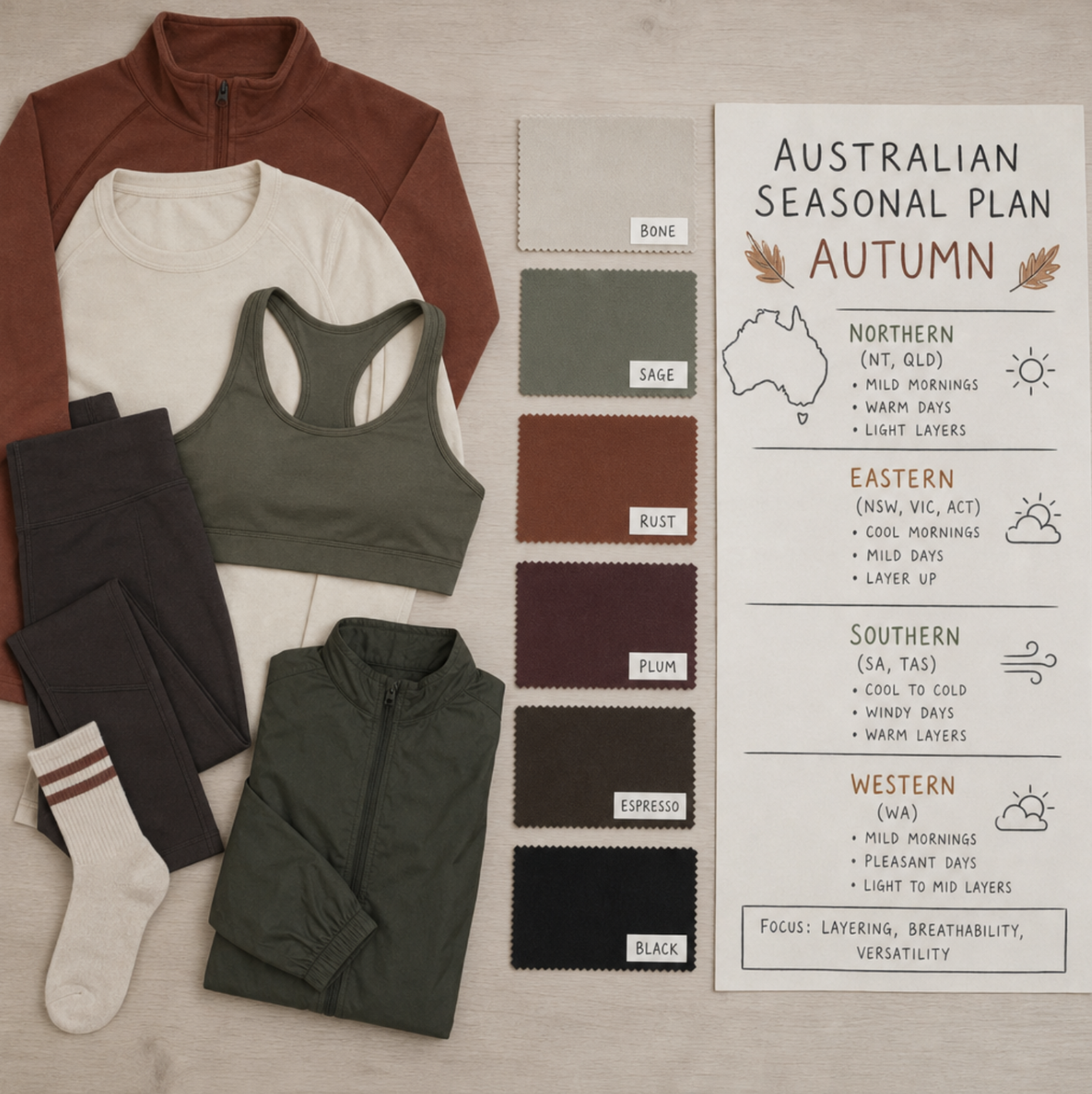
Australia’s autumn runs from March through May, but a single national weather story is inadequate. Tourism Australia distinguishes the country’s conventional four-season regions from northern tropical areas, where wet and dry seasons are more relevant. Build the range around your customers’ locations and activities rather than importing a Northern Hemisphere autumn calendar. (australia.com)
For a Melbourne or Hobart customer brief, consider testing a layering system with a base layer, removable mid-layer and outer piece. For a Brisbane-focused brief, explore lighter alternatives before committing to heavy brushed fabrics. Treat these as development hypotheses, then validate them with customer feedback and local sales information.
Organise the proposed range by wearing occasion:
- Early starts: Trial long-sleeve tops beneath a removable layer, checking comfort when the wearer becomes more active.
- Training sessions: Prioritise movement, coverage and recovery testing over a heavier fabric chosen simply because it looks autumnal.
- Everyday transitions: Sample overshirts, relaxed joggers or zip-through layers that work with existing wardrobe pieces.
Keep colour planning equally disciplined. Choose a core palette that allows tops, bottoms and layers to coordinate, then add accents selectively. Ask whether each new colour serves a distinct customer need before expanding the assortment.
How do recycled textiles compare with natural fibers?
Recycled textiles and natural fibers answer different sourcing questions, so neither category should automatically win. “Recycled” describes material history; “natural” describes fibre origin. Compare actual fabric specifications and supporting evidence rather than treating either word as proof of superior overall environmental performance. Broad environmental claims can create misleading impressions, as the Australian Competition and Consumer Commission explains. (accc.gov.au)
Recycled polyester: investigate the input and the finished fabric
Recycled polyester is worth investigating where your design brief calls for a synthetic fabric. Ask whether the input comes from bottles, textile waste or another source. Textile Exchange notes that post-consumer bottles are commonly used for recycled polyester and encourages development of textile-to-textile recycling; these are different material pathways and should not be presented interchangeably. (textileexchange.org)
Request samples against your intended application. For leggings, assess opacity during movement, waistband stability and recovery after repeated stretching. For a mid-layer, examine surface wear, seam appearance and comfort beneath an outer garment.
Remember that recycled synthetic fabrics do not eliminate microplastic concerns. The European Environment Agency identifies microfibre release across the textile life cycle, including from synthetic clothing. Avoid presenting recycled polyester as pollution-free. (eea.europa.eu)
Natural fibres: evaluate comfort without assuming perfection
Wool offers a relevant starting point for autumn layering: its fibre structure provides insulation, and it can absorb moisture vapour. Woolmark describes these properties as contributors to moisture and temperature management. Still, assess the finished garment rather than assuming every wool fabric will feel or perform alike. (woolmark.com)
For cotton-based casual pieces, request samples in the proposed construction and compare them through your wear-and-wash process. Include softness, shrinkage, drying experience and shape retention in the assessment. Keep sourcing evidence separate from comfort observations: a pleasant hand feel does not establish an environmental benefit.
Design the whole garment, not just its fibre label
Build a shortlist around complete fabric-and-garment combinations. Instead of asking for a universally “sustainable fabric,” describe a specific product, its wearer and the conditions it must handle. This makes supplier discussions more focused and gives your team a clearer basis for approving samples.
A compact development matrix can help:
| Proposed autumn piece | Material route to investigate | Priority checks before approval |
|---|---|---|
| Training leggings | Recycled synthetic blend | Stretch recovery, opacity, seam comfort and documented composition |
| Lightweight base layer | Fine wool or another suitable construction | Next-to-skin comfort, layering fit and care requirements |
| Casual sweatshirt | Cotton-based or recycled-content construction | Shape retention, surface wear and wash results |
| Transitional overshirt | Fabric selected for the intended structure | Movement, layering space, fastening security and care |
These are sampling routes, not guaranteed specifications. Ask suppliers to propose options against the same performance brief so the comparison stays meaningful.
Scrutinise details that the headline fabric story might overlook. Review pocket bags, waistbands, sewing threads, trims, prints and linings. Record which components are included in any recycled-content statement rather than letting a claim about the main fabric imply that the entire garment has the same composition.
Also request a realistic end-of-life explanation. Treat “contains recycled material” and “can be recycled after use” as separate claims requiring separate support. The ACCC’s guidance emphasises clear, accurate claims and disclosure of relevant qualifications. (accc.gov.au)
What evidence should Australian brands request from suppliers?
Australian brands should request evidence tied to the specific material and order, not rely on a supplier’s general sustainability presentation. The documentation should identify composition, substantiate claimed recycled content and clarify the scope of any certification. Textile Exchange distinguishes scope certificates, which establish a company’s certified capability, from transaction certificates, which verify specific certified products. (hub.textileexchange.org)
Use this checklist before approving bulk production:
- Confirm composition. Obtain a written fibre breakdown and clarify whether percentages refer to the main fabric or the whole garment.
- Identify recycled inputs. Ask about feedstock origin and the evidence supporting its recycled status.
- Check certification scope. Verify the relevant organisation, material, process and documentation rather than accepting a logo alone.
- Match evidence to the order. Establish which records will accompany the actual purchase and shipment.
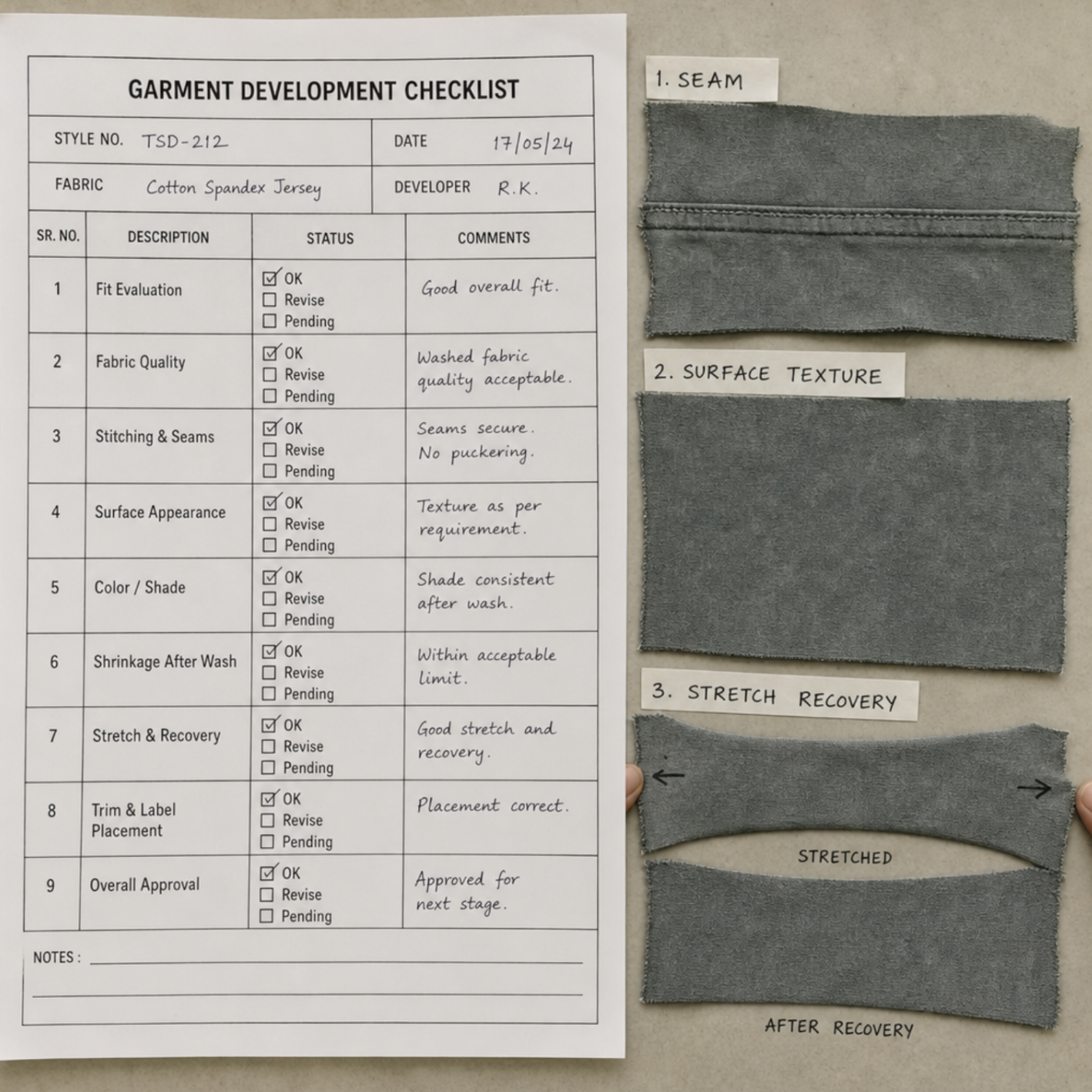
- Agree on testing. Set approval criteria for fit, washing, colour transfer, surface wear and intended performance.
- Approve wording separately. Ensure packaging and product-page claims match the evidence available.
Understand what a standard does—and does not—cover. Textile Exchange’s Recycled Claim Standard verifies and tracks recycled material through the supply chain; it does not assess chemical use or wider social and environmental production conditions. Do not describe recycled-content verification as proof of every aspect of sustainability. (textileexchange.org)
Make wear testing part of the sustainability brief
Ask sample wearers to follow realistic routines rather than commenting only on first impressions. Include sitting, walking, stretching, layering and the intended training activity where relevant. Record observations against the same questions for every candidate fabric.
Photograph samples before testing and after the agreed care cycles. Check hems, knees, elbows, waistbands, pocket openings and other design-specific stress points. Keep an approved reference sample so later production reviews have something concrete to compare against.
Give care instructions the same attention as fit. Ask whether customers can reasonably follow the proposed washing and drying routine. If a sample needs unusually demanding care to retain its appearance, reconsider whether it suits the intended everyday use.
Include repair considerations in the review. Check access to replaceable fastenings, spare trims and straightforward seam repairs where the design allows them. Longer use is an important part of reducing textile impacts, so the development brief should extend beyond the first sale. (eea.europa.eu)
Turn verified material details into Australian SEO content
Build Australian search visibility around useful answers rather than repeated green terminology. Google recommends people-first content that leaves readers better equipped to achieve their goals. Apply that principle by explaining composition, garment purpose, care and evidence—not by repeating “sustainable textiles Australia” across every paragraph. (developers.google.com)
Treat keyword ideas as hypotheses, not proven demand. Research phrases such as “recycled activewear fabrics Australia,” “autumn activewear Australia” and “natural fibre autumn clothing” against your actual audience and offering. Separate wholesale sourcing intent from consumer shopping intent so each page addresses the right reader.
For collection and product pages, consider these actions:
- Use descriptive titles and headings. Name the garment category and relevant material attribute without promising unsupported environmental superiority.
- Write distinct descriptions. Explain the particular garment’s fit, composition, layering role and care instead of copying one sustainability paragraph everywhere.
- Connect related information. Link material explanations to relevant collections and care content using clear, descriptive wording.
- Describe images accurately. Use alt text that explains the garment or fabric detail shown rather than inserting a list of locations and keywords.
These recommendations align with Google’s emphasis on descriptive page content, useful links and meaningful image descriptions. They are foundations for clarity and discoverability, not ranking guarantees. (developers.google.com)
Mention Sydney, Perth, Adelaide or other Australian locations only when the page provides genuinely relevant information. Do not invent local manufacturing, offices or delivery capabilities to create geographical relevance.
Keep the environmental message specific
Before launch, review the collection name, product copy, swing tags, imagery and advertisements together. The ACCC warns that even factually correct statements can mislead through their overall impression, including visual elements. It also cautions against broad terms such as “eco-friendly” and “sustainable” when they imply benefits the business cannot substantiate. (accc.gov.au)
Prefer a documented composition statement over a sweeping promise. Explain which component contains recycled material, identify any relevant limitations and make supporting information easy to find. Do not add emissions, water-saving or biodegradability claims merely because a supplier describes a fabric as recycled or natural.
Create an internal claims record linking each published statement to its evidence and reviewer. Update it whenever the fabric, supplier, construction or approved wording changes. This gives merchandising, sourcing and marketing teams one consistent reference.
Build an autumn range around evidence and everyday use
Start with the Australian customer’s routine, define each garment’s job and compare materials against that brief. Then verify composition, test samples and publish only the claims the evidence supports.
When preparing a discussion with ZIYANG B2B activewear manufacturer, bring your product matrix, target locations, performance priorities and documentation checklist. Ask which options can meet those requirements before committing to a material story. The strongest autumn collection is not the one with the boldest green language, but the one whose products and explanations stand up to scrutiny.