The Ultimate Fall Capsule Activewear Wardrobe: 5 core long-sleeve and pant pieces to mix and match all season
A fall capsule activewear wardrobe is a coordinated collection of long-sleeve tops and pants designed to layer, mix, and serve distinct wearing occasions. For wholesale buyers and brands considering ZIYANG for activewear manufacturing, the opportunity is to develop five complementary styles rather than five disconnected products. This guide turns that concept into a practical sourcing brief, covering fabric selection, garment construction, assortment planning, MOQ, and lead times.
What belongs in a fall capsule activewear collection?
A focused fall capsule activewear collection can start with three long-sleeve tops and two pants: a fitted training top, a relaxed crewneck, a quarter-zip layer, a full-length legging, and a tapered jogger. Together, these activewear essentials provide a framework for fitted workout looks, adjustable layering, and relaxed outfits. Treat this as a proposed assortment, then refine it around your customers, sales channels, and intended activities.
Before developing samples, give each style a clear commercial role. The fitted top might anchor studio merchandising, while the quarter-zip supports an outdoor training story. The jogger should offer something the legging does not, rather than simply repeating its styling in a looser shape.
For buyers, the central discipline is compatibility. Review proportions, colors, hand feel, and intended use across the collection before approving any individual garment.
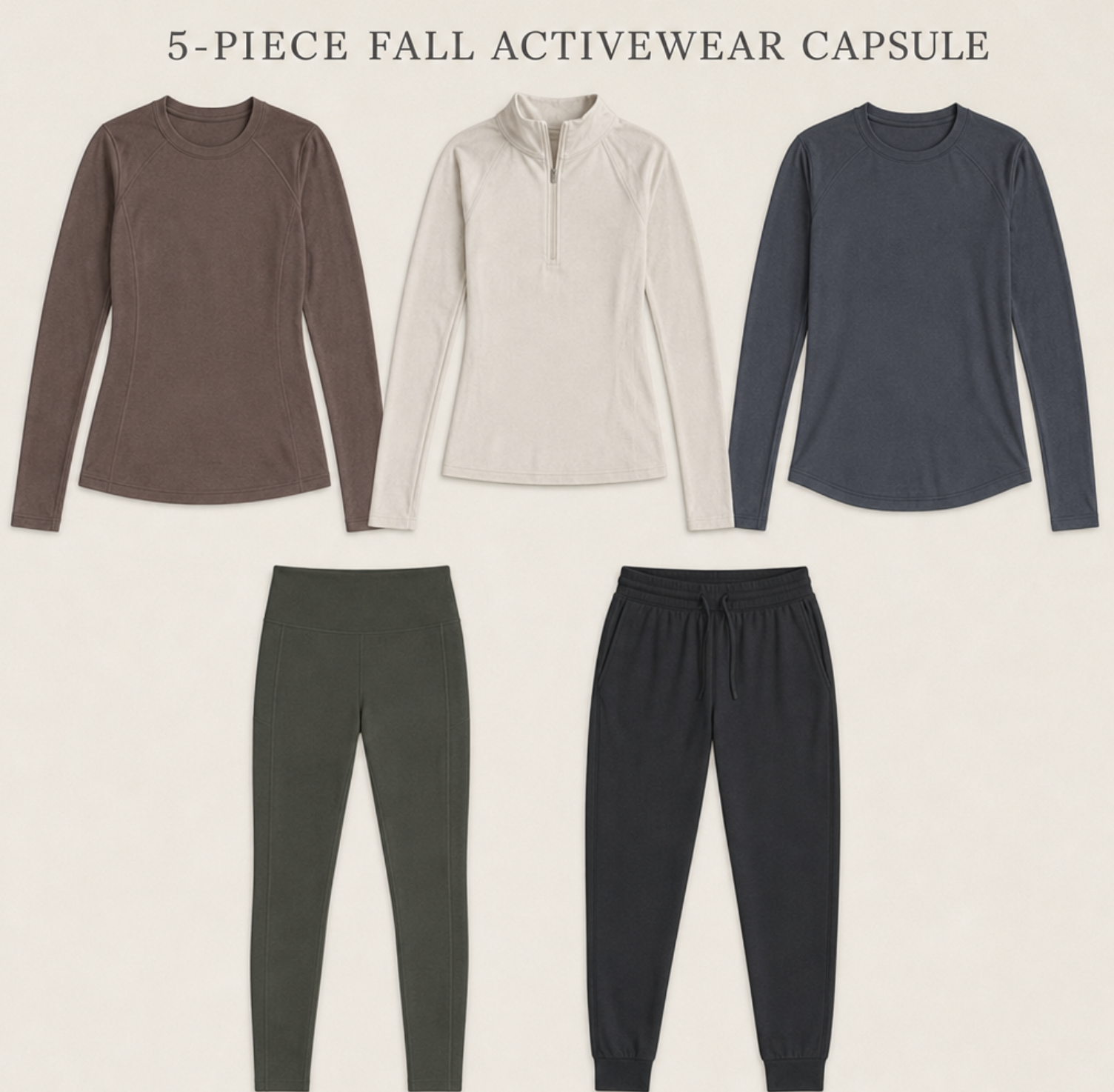
The five core pieces and their manufacturing priorities
1. A fitted long-sleeve training top
Start with a close-fitting top intended to work alone or beneath the quarter-zip. Consider nylon-elastane or polyester-elastane jersey as sampling candidates, but specify the desired feel, coverage, and movement instead of approving a fabric by fiber content alone. Ask for fabric swatches and a sewn prototype before committing to the final material.
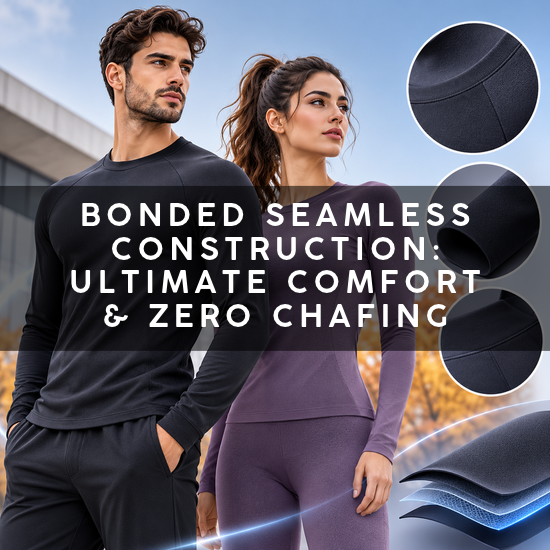
In the tech pack, define body length, sleeve length, neckline shape, and intended ease. Evaluate reaching overhead, bending, and wearing the top beneath another sleeve. If thumbholes are included, check their placement on the fit model rather than treating them as a decorative detail.
Buyer takeaway: Keep the first version focused. Approve the core fit before adding contrast panels, elaborate seam lines, or multiple pocket options.
2. A relaxed long-sleeve crewneck
Give the crewneck a different assignment: an easy outer layer for warm-ups, travel, and everyday styling. Request samples in French terry, interlock, or a suitable double-knit, then compare their appearance against the collection brief. Decide whether the intended look is softly draped, structured, or deliberately oversized.
Specify shoulder position, sleeve volume, body length, and hem treatment. Review the crewneck over the fitted top so the approved measurements reflect its layering role. Include neckline and cuff appearance in wash evaluations; dimensional stability and appearance retention are established textile testing categories. (intertek.com)
Buyer takeaway: Use the crewneck to introduce a relaxed silhouette without abandoning the capsule’s shared color palette and branding language.
3. A quarter-zip long-sleeve layer
The quarter-zip should provide a distinct layering option, not simply duplicate the crewneck with a zipper attached. Consider a smooth double-knit or lightly brushed fabric for sampling, with the choice guided by the intended activity and climate. Establish whether the garment is a close midlayer or a roomier outer layer before pattern development.
Put zipper length, collar height, zipper garage, and internal finishing into the specification. During fittings, inspect the closed collar, the open neckline, and the zipper area while the wearer bends forward. Ask whether the proposed zipper and seam construction suit the selected stretch fabric.
Buyer takeaway: Approve the zipper, collar, and body fabric together. A visually appealing trim should not be approved separately from its function in the garment.
4. A full-length performance legging
Use the legging as the fitted bottom in the assortment. Nylon-elastane or polyester-elastane interlock can be starting points for sampling, but write separate requirements for fit, coverage, stretch, and recovery. Avoid making a compression claim simply because the sample feels tight.
Specify waistband height, rise, inseam, gusset construction, and pocket placement. Assess coverage in movement and across the intended size range, including lighter proposed colors. Have wear testers check waistband rolling, crotch comfort, and pocket behavior with the intended contents.
For close-to-skin seams, request a construction trial. Coats identifies coverseam, overlock, and flatseam options with different thread combinations, emphasizing that fabric and garment construction affect thread selection. Use the trial to evaluate softness, extension, and appearance rather than relying on a seam name alone. (cdn.coats.com)
Buyer takeaway: Approve leggings through movement and laundering checks, not a standing fit photograph alone.
5. A tapered training jogger
The jogger provides a looser alternative for customers who do not want a fitted bottom in every outfit. Compare stretch double-knit, French terry, or stretch-woven samples according to the proposed use. Choose the material that supports the intended silhouette rather than forcing the jogger into the legging fabric.
Define thigh ease, knee shaping, taper, ankle opening, and waistband construction. Review pocket depth and opening angle with a phone or other intended item. Ask the factory to propose reinforcement at pocket openings and drawcord exits, then inspect the sample for bulk and appearance.
Buyer takeaway: Check the jogger while seated, walking, and squatting. Keep its comfort and mobility brief separate from the legging’s fitted performance brief.
Build fabric specifications around intended performance
For versatile activewear, a fabric description should be more useful than “soft stretch knit.” Request fiber composition, knit structure, fabric weight in grams per square meter, usable width, finish details, and available colors. Add approved swatches to the development record so purchasing and production teams share the same reference.
Separate appearance preferences from performance requirements. “Peached hand feel” describes a surface preference; “moisture-wicking” is a functional claim that needs supporting evidence. CottonWorks’ moisture-management guidance illustrates how formulation, fabric construction, and finishing can affect drying behavior, reinforcing why fiber names alone are not a complete specification. (cottonworks.com)
Ask the supplier to propose testing appropriate to the end use, then agree on methods and acceptance criteria before bulk production. Textile testing can assess properties including pilling, abrasion resistance, dimensional stability, and colorfastness. Those evaluations address different questions; one favorable result does not establish overall garment performance. (intertek.com)
Where two styles might share a fabric, sample both first. Approve shared sourcing only if each garment still meets its own fit and appearance requirements.
Make the mix-and-match story visible
Treat fall workout outfits as planned merchandising combinations, not a benefit left for customers to discover. Build a sample rail showing how each top pairs with both bottoms, then assess the proportions in complete looks. Photograph the proposed combinations before final color approval so awkward overlaps become visible early.
Use an outfit matrix to guide development and sales presentation:
| Combination | Proposed merchandising role | Sample review priority |
|---|---|---|
| Fitted top + legging | Coordinated training outfit | Waistband overlap during movement |
| Fitted top + jogger | Relaxed training alternative | Top length against the jogger rise |
| Crewneck + legging | Warm-up and everyday look | Hem position and overall balance |
| Quarter-zip + legging | Layered workout outfit | Sleeve room over the fitted top |
| Quarter-zip + jogger | Coordinated travel look | Collar, taper, and trim consistency |
Start with a restrained palette—for example, a dark foundation, a second neutral, and one seasonal accent. This is an assortment proposal, not a requirement to launch every style in every shade. Prioritize combinations that support your intended retail presentation.
Review actual materials together under agreed lighting conditions. If matching shades across different fabrics is important, document the approved references rather than relying on color names.
How should buyers plan MOQ and lead times?
Buyers should confirm MOQ and lead times at the style, color, material, and delivery level before committing to a capsule wardrobe order. MOQ means minimum order quantity: the smallest quantity a supplier agrees to accept under specified conditions. Lead time is the agreed period needed to complete a defined stage, so every quotation should state what starts the clock and what the quoted period includes.
For a ZIYANG sourcing discussion, request written clarification rather than assuming company-specific minimums, stock availability, or production capacity. None of those details should be inferred from the five-piece concept.
Clarify the quantity rules behind the quotation
Ask whether the MOQ applies to each style, each color, or the total order. Then ask separately about fabric dye lots, custom trims, labels, packaging, and size allocation. Record which requirements are fixed and which could change with a different material or customization choice.
Use these questions to compare proposals:
- Fabric: Can proposed styles share an approved material, and how would that affect purchasing quantities?
- Color: Is the quotation based on an available shade or a custom-dyed color?
- Sizing: Are quantities flexible across sizes, or is a fixed size ratio required?
- Customization: Do printed logos, embroidery, or branded trims introduce separate minimums?
- Reorders: Would a repeat order use the same minimums and approval process?
Separate development from bulk production
Request a milestone schedule covering prototypes, fit revisions, color approvals, size sets, pre-production approval, bulk manufacturing, inspection, and shipment. Ask which activities can overlap and which require a previous approval. Include approval responsibilities on the buyer’s side, not just factory tasks.
Confirm whether the quoted production period begins after deposit, material readiness, pre-production approval, or another agreed event. Keep freight and receiving plans distinct from factory completion. Work backward from the required warehouse receipt date and identify where contingency time belongs.
Approve the capsule as a system before bulk production
Individual sample approvals are necessary, but add a final collection review. Put all five styles together and check whether the approved fit, colors, branding, and finishing still form one coherent range. Include representative sizes rather than reviewing only the base sample size.
Create a shared approval checklist with responsibilities and pass criteria:
- Fit and grading: Record key measurements, tolerances, size-to-size changes, and movement observations for each silhouette.
- Material identity: Match fabric references, composition, weight, finish, and approved color standards to the bill of materials.
- Wash performance: Agree on dimensional-change and appearance evaluations appropriate to the care instructions. (intertek.com)
- Color durability: Consider washing, rubbing, and perspiration testing where relevant; these evaluate different forms of fading or dye transfer. (intertek.com)
- Construction: Inspect seam appearance, stitch consistency, zipper operation, pocket attachment, and waistband finishing against approved samples.
- Packing: Confirm labels, size identification, packaging, carton assortment, and purchase-order references before shipment.
Keep comments specific enough to act on. Instead of “improve waistband,” describe the observed issue, the affected size, the movement that revealed it, and the required revision. Retain an approved pre-production sample as the reference for subsequent inspection.
For purchasing decisions, compare quotations against the same approved brief. A lower quoted price is difficult to evaluate if another proposal includes different fabric, trims, testing, or packaging. Ask suppliers to identify exclusions and proposed substitutions explicitly.
A focused fall range starts with a focused brief
The strongest starting point for fall activewear is five clearly differentiated pieces with an intentional relationship to one another. Keep the fitted top, crewneck, quarter-zip, legging, and jogger connected through color and styling, while giving each its own manufacturing requirements.
Bring ZIYANG a consolidated development brief: intended activities, target customer, tech packs, fabric references, quantity scenarios, testing expectations, and required delivery milestones. Confirm capabilities and commercial terms directly, then use sample evidence—not assumptions—to decide which styles are ready for production.