Cotton vs Synthetics in Activewear Why B2B Brands Are Pivoting to Natural Performance Blends
Natural performance blends give B2B activewear brands a way to combine cotton-led comfort with engineered moisture management, rather than choosing between softness and technical function. For sourcing teams evaluating cotton activewear against synthetic activewear, the strongest decision starts with the garment’s intended use and verified fabric performance. This article outlines the trade-offs and offers a development framework for discussions with ZIYANG, a premium activewear manufacturing company.
Why are B2B brands considering natural performance blends?
Natural performance blends offer a route to differentiated fitness apparel: familiar cotton comfort, adaptable fabric construction, and a material story that can be supported with sourcing evidence. Cotton Incorporated’s TransDRY technology, for example, demonstrates that moisture management is not exclusive to synthetic fibers. However, this innovation should not be mistaken for proof that the whole industry is abandoning polyester. (cottonworks.com)
The business opportunity is selective, not universal. A brand developing studio collections might prioritize a soft handfeel and controlled drape, while a running specialist might make drying performance its first approval gate. Treat these as separate product briefs rather than asking one fabric to serve every activity.
For a United States–focused launch, ZIYANG buyers can organize development around intended regional use: humid outdoor training, air-conditioned studios, or transitional layering. These are proposed development scenarios, not claims about ZIYANG’s existing customers or manufacturing locati0n. They make a more useful starting point than a broad request for “premium breathable materials.”
How do cotton and synthetics compare in activewear?
Cotton’s absorbency can support comfort, but conventional cotton fabrics can retain moisture when saturated; engineered cotton constructions can change that behavior. Synthetic fabrics are not automatically superior either: moisture movement and drying depend on the finished textile, not simply its fiber label. An activewear comparison should therefore evaluate production-representative fabrics under comparable conditions. (cottonworks.com)
Moisture movement and drying are different outcomes
Absorption, wicking, and drying should not be treated as interchangeable benefits. AATCC provides separate methods for liquid moisture management, vertical wicking, and drying rate, reflecting the different questions each measurement answers. A fabric that spreads liquid effectively still needs a separate assessment of how quickly it dries. (aatcc.org)
Cotton Incorporated explains that TransDRY fabrics combine absorbent and repellent yarns to reduce overall absorbent capacity and encourage moisture spreading. That is a useful example of engineered cotton performance—not a guarantee that every cotton blend dries faster than polyester. The organization also notes that formulation, construction, and finishing affect drying results. (cottonworks.com)
Odor deserves evidence, not blanket promises
Odor can be another meaningful comparison point. A published study involving 26 participants found that polyester shirts smelled more intense and less pleasant than cotton shirts after a spinning session followed by incubation. Those conditions matter: the finding does not establish that all cotton workout clothing is odor-free or that every synthetic garment performs poorly. (pubmed.ncbi.nlm.nih.gov)
For procurement teams, the practical response is to include wear trials and laundering in approval. Record the activity, wear duration, storage conditions, and washing procedure. Without that context, a “freshness” claim is difficult to interpret or reproduce.
Build the fabric shortlist around the product
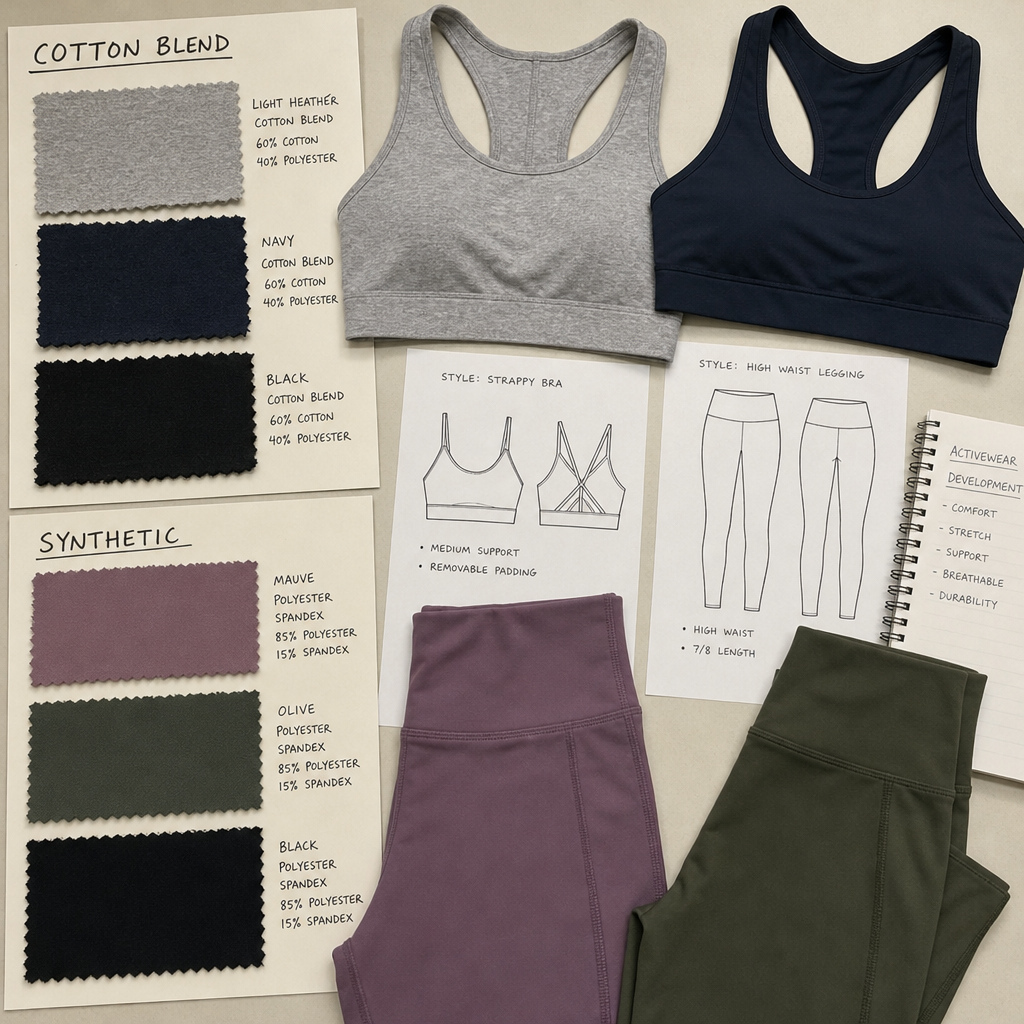
Start with the garment’s job, then decide which compositions deserve sampling. Avoid specifying a cotton percentage before defining the required moisture behavior, stretch recovery, appearance, and wash performance. The following shortlist is a development framework, not a ranking of guaranteed outcomes.
|
Product brief |
Candidate direction to sample |
Approval priorities |
|---|---|---|
|
Studio and recovery tops |
Cotton-rich or cotton–cellulosic blends |
Handfeel, drape, dimensional stability, and moisture behavior |
|
High-sweat training shirts |
Engineered cotton blends alongside synthetic benchmarks |
Wet cling, liquid transport, drying rate, and post-wash performance |
|
Fitted leggings and support garments |
Stretch constructions with clearly defined fiber roles |
Recovery, opacity under extension, seam behavior, and fit retention |
|
Lifestyle-to-training layers |
Cotton blends or cellulosic blends |
Surface appearance, abrasion, laundering, and garment shape |
Do not assume a successful shirt fabric will work in leggings. Set separate acceptance criteria for each category, including the garment’s fit and construction. Where support or compression is part of the brief, evaluate the complete garment rather than approving the concept from a swatch alone.
Cellulosic innovation expands the options
Modal and lyocell are regenerated cellulosic fibers, not unprocessed natural fibers. Lenzing describes producing these materials from wood-derived cellulose, with production chemistry differing by fiber type. That distinction helps sourcing teams discuss natural-origin materials without implying that they require no industrial processing. (lenzing.com)
Lenzing identifies softness and moisture control as benefits of its TENCEL Lyocell and Modal fibers, and describes blending them with cotton and polyester. These properties make them candidates for development where tactile comfort matters. They do not remove the need to test the finished fabric’s durability or drying behavior. (b2b.tencel.com)
Ask suppliers to explain the purpose of every component. Is the cellulosic fiber intended to change handfeel, moisture absorption, or drape? Which construction choices address shape retention and surface appearance? A clear answer is more valuable than a long list of fashionable fiber names.
Keep branded technology claims separate from general fiber claims. If a proposal uses a proprietary performance name, request the technical specification, relevant test reports, and confirmation of any branding permissions. Do not transfer another supplier’s published results to an untested substitute.
Sustainability requires a full material story
“Natural” does not automatically mean lower impact across every environmental measure. UNEP’s textile value-chain assessment identifies cotton cultivation as an important water-scarcity hotspot, while synthetic fiber production and wet processing are important climate-impact hotspots. The useful sourcing question is which impacts a specific proposal addresses—and which it leaves unresolved. (wedocs.unep.org)
Lyocell production can offer process advantages, but supplier specificity matters. Lenzing reports recovering approximately 99.8% of the solvent in its lyocell process. That figure describes its stated production system; it should not be applied automatically to every wood-based fiber or finished garment. (lenzing.com)
For eco-friendly activewear positioning, build an evidence file before writing campaign copy:
- Fiber origin: Request traceability information and documentation supporting any certified material claim.
- Processing: Ask what evidence covers dyeing, finishing, chemical management, and production impacts.
- Comparison boundary: Establish whether a footprint assessment covers fiber, fabric, or the finished garment.
- Useful life: Pair environmental ambitions with measurable durability and realistic care requirements.
Choose specific statements over broad superiority claims. “Contains documented recycled material,” when supported, says more than “planet-friendly.” Keep the commercial message aligned with exactly what the evidence establishes.
Turn supplier sampling into a repeatable approval process
A sample should answer a defined question, not simply look and feel promising. For discussions with ZIYANG, prepare a brief that connects product positioning to measurable acceptance criteria. Keep a familiar benchmark in the program so the team can judge whether a new blend delivers a worthwhile improvement.
- Define the use case. Specify activity, expected sweat exposure, fit, climate, and intended care routine.
- Control the comparison. Record composition, fabric weight, construction, finishing, and color so differences remain visible.
- Separate performance tests. Consider AATCC TM195 for liquid moisture management and TM201 for heated-plate drying rate; agree on suitable methods with the laboratory. (aatcc.org)
- Validate after laundering. Establish wash checkpoints and reassess dimensions, appearance, recovery, and any claimed moisture-management benefit.
- Approve the garment. Combine laboratory findings with structured wear trials before committing to bulk production.
Care instructions belong in development, not at the end. Ask the supplier to propose laundering conditions for the exact blend, finish, and garment construction, then validate those conditions. Avoid assigning one generic care routine to all cotton, modal, or lyocell products.
Commercial checks should sit beside technical approval. Confirm minimum quantities, replenishment availability, shade consistency expectations, lead times, and how material substitutions will be controlled. A promising fabric is not a dependable sourcing solution until the production proposal is workable.
The strongest pivot is toward verified performance
Cotton versus synthetics is not a winner-takes-all sourcing decision. For B2B brands, the better strategy is to establish what each collection needs, compare candidate moisture-wicking fabrics fairly, and retain only claims the finished product can support.
Bring ZIYANG a focused development brief covering target market, garment category, performance priorities, and required evidence. That gives discussions with a premium activewear manufacturer a practical direction: a blend selected for its job, not merely its label.