Seamless vs. Cut-and-Sew Bamboo Activewear Brand Guide
Seamless and cut-and-sew are two ways to make bamboo activewear. This Seamless vs. Cut-and-Sew Bamboo Activewear: Choosing the Right Construction for Your Brand guide helps you compare fit, design needs, fiber proof, and whether the build can work. Seamless uses knit shapes and fewer joins. Cut-and-sew uses fabric panels that someone cuts and stitches.
If you are working with activewear company ZIYANG, compare fit, design needs, fiber proof, and whether the build can work. Do not say one method is always better.
Use this guide to prepare a clearer brief, compare samples, and choose the build around your customer’s workout.
What is the difference between seamless and cut-and-sew bamboo activewear?
Seamless activewear uses knitting tech to make tubular or garment-shaped sections with fewer seams. Cut-and-sew starts with a person cutting fabric into pattern pieces and stitching them together.
A circular-knit “seamless” item is not always seam-free. One maker calls these tubular parts semi-finished, not full garments. (willy-hermann.com)
Put that in your tech brief. Ask which seams remain, how they finish openings, and whether they knit in or attach waistbands or other parts. Judge the real build, not the word seamless.
The fiber question is separate. In the United States, the Federal Trade Commission makes a distinction. They differentiate between real bamboo fiber and rayon or viscose made from bamboo pulp. You should name the latter clearly, such as “rayon made from bamboo,” not just bamboo. (ftc.gov)
For talks with ZIYANG, you should record both points: what the fiber is and how the garment will be made. One does not replace the other.
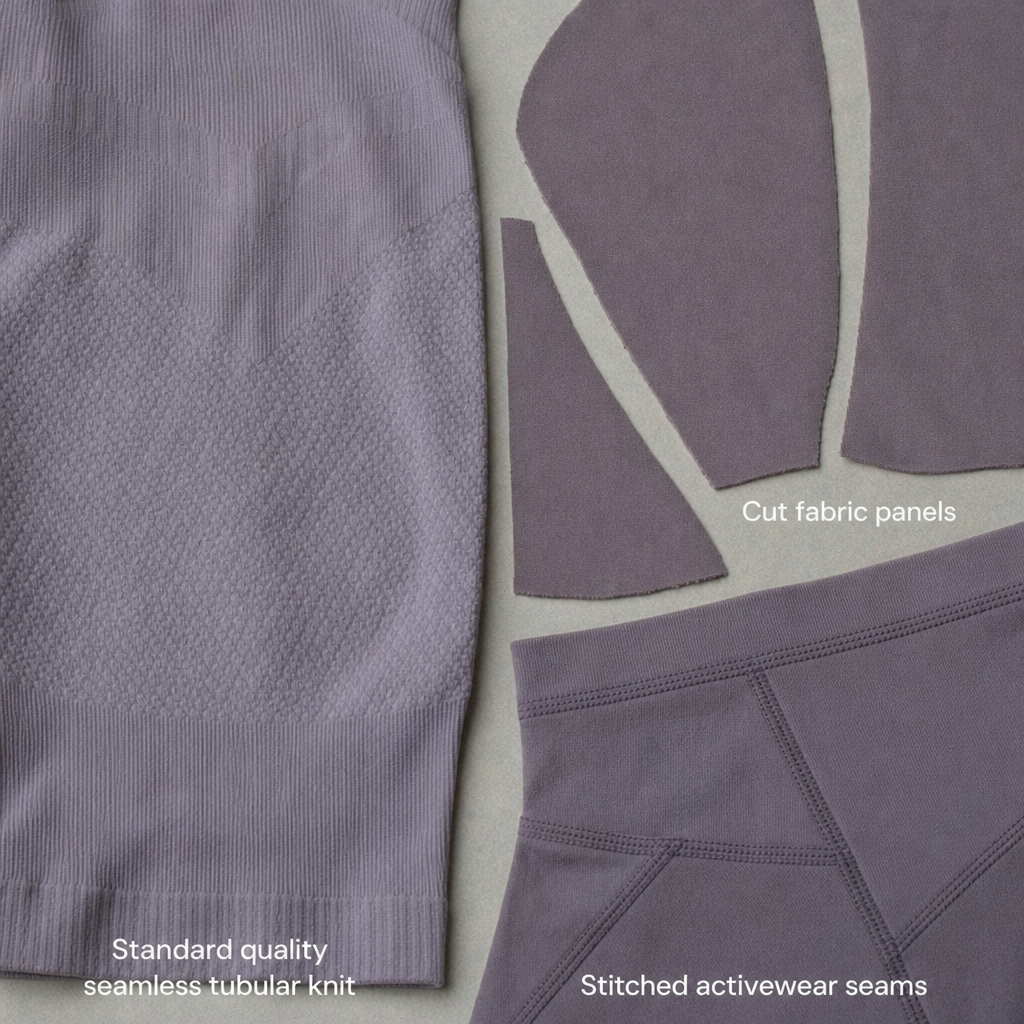
Seamless construction puts structure into the knit
Seamless tech can add different knit structures and stretch in different parts of a garment. Santoni notes engineered zones, varied stretch, and shifts between yarn types as possible features of its seamless systems. These are system features, not proof that every mill, yarn, or bamboo blend can do them all. (santoni.com)
Use seamless when your design needs built-in texture, a smooth look, or stretch zones in set places. Instead of asking for a “premium seamless legging,” say what you really want. You want a stable waist, easy knee movement, and a surface that looks good when stretched.
Keep your sample review specific:
- Map the joins. Inspect where they sit and how they finish, especially where the garment bends or rubs on gear.
- Check each knit zone. See whether texture changes create see-through spots or pressure during movement.
- Review each size. Ask how machine width, knit settings, and finishing affect the full size range.
- Confirm yarn fit. Ask for written proof that the yarn blend works with the chosen knit process.
Circular seamless production uses machine width to fit different garment sizes. Ask the supplier how they will cover your full size range, not just a middle size sample. (willy-hermann.com)
Cut-and-sew makes panel layout a design choice
Cut-and-sew starts with pattern pieces and join lines. SHIMA SEIKI separates regular cut-and-sew from garments knit straight into a full 3D shape. The real design question is where separate pieces help, not how many seams you can remove. (shimaseiki.com)
Choose this route when you need a pocket layout, contrast panels, separate lining, or a more detailed shape. Show those needs in a sketch and ask the maker to suggest the build. Do not assume a photo shows the real construction.
For example, a training legging may need a phone pocket that stays easy to reach while moving. A studio top may need a neckline that keeps coverage during forward bends. In either case, ask for a sample that proves the feature in use, not only on a hanger.
Treat seam review as part of development. Check the garment inside out, stretch the joins through the full motion range, and review the finish after washing. Note any discomfort or shape change before you approve production.
Which build fits your collection’s priorities?
Choose the build that meets your key design and wear needs in a tested sample. Look at seamless when knit-in features are central. Look at cut-and-sew when panel placement and assembled details matter most. If both can work, ask for side-by-side development quotes before you decide.
Use this table as a briefing tool, not a universal ranking:
| Collection priority | Seamless focus | Cut-and-sew focus |
|---|---|---|
| Clean exterior | Ask which joins are visible | Set the seam place and finish |
| Zoned stretch | Ask which zones can be knit into the yarn | Ask whether panel or fabric choices fit |
| Functional storage | Check pocket fit and attachment | Set pocket place, opening, and reinforcement |
| Size consistency | Ask for knit and size details | Ask for graded measurements and pattern check |
| Brand detailing | Check knit-in and applied options | Check panel, trim, and applied-detail options |
These questions turn the gap between knit-in seamless builds and assembled fabric pieces into clear sample rules. The options still depend on the machine and product spec. (santoni.com)
You do not need one build for the whole line. Review each style individually, then ensure the final range feels cohesive in color, fit, and use. Do not accept a weaker item just to keep one construction story.
Green claims need proof beyond the build
Neither build is automatically green. Knit-to-shape can cut waste, but someone must prove that benefit for the real production path. Do not stretch SHIMA SEIKI’s whole-garment notes to every circular-knit seamless item. (shimaseiki.com)
Ask for proof instead of treating bamboo sourcing as the whole story. The FTC warns that bamboo-made rayon does not keep the plant’s traits by default, and that environmental or germ claims need proof. Do not sell bamboo workout gear as naturally germ-fighting or eco-friendly activewear without the right evidence. (consumer.ftc.gov)
Before you use phrases such as organic bamboo clothing, sustainable workout clothes, bamboo workout gear, or eco-friendly activewear, ask for:
- Fiber papers: The generic fiber names, blend shares, and records for the material.
- Claim proof: Papers that show what each organic or green claim covers.
- Production notes: A plain note on the process and the basis for any waste-cut claim.
- Product proof: Test reports that support the performance claims you plan to publish.
Keep green copy specific and supportable. The FTC says sellers must provide accurate descriptions of textiles and claims. Simply repeating what a supplier says is not enough proof. (ftc.gov)
Compare samples and quotes on equal terms
For your ZIYANG development brief, set a common base before you ask for prices. State the use, fiber mix, target fabric weight, size range, colors, features, packaging, and test needs. Ask the supplier to show what changes each build route needs.
Do not assume fewer seams mean a lower quote or a shorter schedule. Ask for a breakdown of development, sampling, materials, knitting or cutting, assembly, finishing, and packaging. Ask which minimums apply by style, color, and size, and get the delivery date in writing.
Use a repeatable sample review:
- Fit in motion: Do the movements for the intended activity; note waistband shift, restriction, and coverage.
- Stretch and look: Check the garment under steady light at real stretch levels, including pocket areas and knees.
- Care and recovery: Follow the care steps, then compare size, look, and shape with your base records.
- Feature performance: Test pocket access, openings, straps, and finishes in the use cases in your brief.
- Approval records: Log the accepted sample, sizes, materials, and fixes so production expectations are clear.
For a United States launch, include fiber-label and marketing-copy review in that sign-off. The FTC’s bamboo rules apply to both ads and labels. A correct label does not make a misleading product description okay. (search.ftc.gov)
Build your ZIYANG brief around the finished product
The strongest call is not “seamless wins” or “cut-and-sew wins.” A documented choice links your customer’s activity, the garment’s build, verified materials, and an approved sample. Keep those priorities visible when design taste and production limits clash.
Explore ZIYANG’s activewear products to find starting points for your line. Prepare your reference designs, target market, material needs, and essential features. Then, ask ZIYANG to confirm if the build will work. Let the finished product—and the proof behind it—earn your brand’s promise.
Q&A
Question: Is “seamless” bamboo activewear completely free of seams?
Short answer: Not always. The guide explains that circular-knit “seamless” items may still have some joins or attached parts. Brands should ask which seams remain, how they finish openings, and whether they knit in features such as waistbands or add them later.
Question: Should a brand choose seamless or cut-and-sew for the whole collection?
Short answer: No. The better approach is to review each style on its own. Seamless works well for styles that need knit-in zones, texture, or a smooth look. Cut-and-sew is better for styles that need pockets, contrast panels, linings, or detailed shaping.
Question: What information should be included in a ZIYANG development brief?
Short answer: The brief should state the intended activity, fiber mix, target fabric weight, size range, colors, key features, packaging, and test needs. It should also ask how each build route affects development, sampling, production, minimums, delivery timing, and final performance.
Question: Can bamboo activewear be marketed as eco-friendly or naturally germ-fighting?
Short answer: Only if the brand has proof for those claims. The guide says that rayon made from bamboo does not always keep the plant’s qualities. The FTC requires clear fiber descriptions and proof for claims about the environment, organic status, or performance.