
Preventing Shrinkage Loss of Shape Pre-Shrinking Treatments Recovery Testing for Custom Cotton Wear
Preventing shrinkage and loss of shape in custom cotton wear takes three coordinated steps: stabilize the fabric before production, test the finished garment, and match care instructions to proven performance. Pre-shrinking treatments address dimensional change after laundering, while recovery testing checks whether stretched fabric returns toward its original shape. This guide explains how to combine both approaches, especially when developing custom cotton yoga wear where fit and movement matter. (cottonworks.com)
Why does cotton clothing shrink or lose its shape?
Cotton clothing changes dimensions because its fabric structure responds to manufacturing tension, moisture, drying, and mechanical action. Processing can stretch fabric away from its relaxed dimensions; laundering gives that structure an opportunity to move again. Knitted cotton is particularly sensitive because its loops can change configuration, affecting both length and width. (cottoninc.com)
The dryer is not the only suspect. Research examining home laundering found that washing and drying both contributed to dimensional change. A cooler wash therefore should not be treated as a guarantee against shrinkage, nor should every fit problem be blamed on dryer temperature alone. (scholars.uky.edu)
It helps to separate three problems before choosing a solution:
- Shrinkage: A measured dimension becomes smaller after the specified care process.
- Growth or poor recovery: Fabric remains extended after stretching and a defined rest period.
- Distortion: Seams twist, panels skew, or components change differently, altering the garment’s balance. (cottonworks.com)
For development purposes, record these as separate findings. A legging that becomes shorter after washing needs a different investigation from one that bags at the knees during wear. Avoid a single “holds its shape” score that hides the distinction.
Also resist universal shrinkage percentages. Construction, yarn, processing history, finishing, and laundering conditions all influence results. A supplier’s measured performance under a named procedure is more useful than a generic expectation for cotton. (cottonworks.com)
Which pre-shrinking treatments work for custom cotton wear?
The appropriate treatment depends on the fabric and garment: controlled relaxation and mechanical compaction are important options for cotton, while chemical crosslinking offers another stabilization route. Cotton blends containing elastane may also require carefully controlled heat setting, but heat setting does not eliminate the cotton component’s shrinkage potential. Select the process through trials rather than assuming one treatment suits every cotton product. (cottonworks.com)
Mechanical compaction and Sanforization
Mechanical compaction shortens fabric through controlled compression. In a rubber-belt compressive shrinking process, moistened fabric travels with an extended belt; as the belt contracts, it compresses the fabric. Drying follows, and wash testing checks the resulting dimensional stability. (sanforized.de)
Sanforized is a trademark associated with a licensed process and testing requirements, not a synonym for every prewashed fabric. Its published woven-fabric standard limits shrinkage or growth to no more than 1% in either direction under its specified testing conditions. That requirement should not be presented as a universal result for all cotton knits or finished garments. (sanforized.de)
For sourcing, ask which process was used and request results for the actual construction being purchased. Do not accept a treatment name as a substitute for a lot-specific performance discussion.
Controlled relaxation and knit compaction
Relaxation drying lets fabric consolidate with limited restraining tension. Knit compactors use compressive forces to bring the loop structure closer together, commonly targeting lengthwise shrinkage. Moisture, machinery settings, and finishing chemistry influence how effectively the treatment works. (cottoninc.com)
For a yoga jersey or interlock, request samples after the proposed finishing route rather than choosing from unfinished swatches alone. Compare usable width, handle, appearance, and wash performance together. Approve the combination that meets the garment brief, not simply the sample with the smallest reported shrinkage.
Chemical stabilization
Resin or crosslinking finishes can improve dimensional stability, but the finishing system requires balance. Cotton Incorporated’s processing guidance emphasizes selecting treatment levels and curing conditions that achieve the desired properties without reducing bursting strength below requirements. Trials are necessary to establish that balance. (cottoninc.com)
If considering this route, include strength and hand-feel assessment in the approval plan. Ask the finisher to identify the chemistry and supporting product documentation. “Chemically stabilized” should begin a technical conversation, not end it.
Heat setting for cotton blends
Heat setting is relevant when cotton fabric contains a heat-responsive component such as elastane. Its timing, tension, and heat exposure can affect stretch and recovery, while uneven processing can produce uneven performance. It is not a stand-alone pre-shrinking solution for the cotton portion. (cottoninc.com)
Have the mill establish settings for the actual blend and construction. A heat press used to apply a logo should never be assumed to provide equivalent stabilization. Treat decoration as a separate production step that needs its own finished-garment check.
A practical pre-shrinking plan for small production runs
For a small label or custom sewing studio, start with a controlled pilot rather than treating the entire fabric order immediately. The following is a proposed development workflow, not a replacement for an industrial finishing specification or laboratory method.
- Define the intended care routine. Decide whether the product will be developed for machine washing, flat drying, or permitted tumble drying. Give the laboratory the same intended routine.
- Identify the incoming material. Record supplier, lot, color, composition, construction, width, and declared finishing. Keep a labeled untreated reference.
- Trial the preparation process. Compare supplier-finished material with any proposed in-house washing and drying route. Keep loading and handling consistent between trials.
- Measure before cutting. Once the trial material is dry and ready for measurement, record its dimensions and usable width. Do not pull it into a preferred shape.
- Make representative samples. Include the intended waistband, thread, seams, labels, and decoration rather than evaluating body fabric alone.
- Repeat the intended care process. Measure the complete sample and compare it with both its starting measurements and the approved fit brief.
Treat the result as a decision point. If the material continues changing unacceptably, investigate the finishing route or change the construction before committing to cutting. Repeating preparation cycles without understanding the result is not a useful specification.
Build the cost sheet around the usable material after preparation. For your pilot, record purchased length, prepared length, usable width, and cutting yield separately. This makes the material implications visible instead of burying them in a general production allowance.
Keep pattern compensation separate from stabilization. If you choose to compensate for measured residual change, document the calculation and validate a sewn sample. Avoid adding an arbitrary percentage to every dimension: approve inseam, rise, waist, and body width individually against the intended post-care fit.
How do you test shrinkage and stretch recovery reliably?
Reliable testing uses defined starting measurements, a repeatable treatment, controlled measurement conditions, and clear acceptance criteria. Dimensional-change testing evaluates what laundering does to size; stretch-and-growth testing evaluates behavior under and after extension. Both are needed when wash stability and movement-related shape retention are part of the product brief. (members.aatcc.org)
Choose methods that answer the right question
Discuss these options with a textile laboratory:
|
Evaluation |
Relevant method or framework |
Main purpose |
|---|---|---|
|
Fabric dimensional change |
AATCC TM135 |
Measures length and width changes after home laundering |
|
Garment dimensional change |
AATCC TM150 |
Evaluates dimensional changes in finished garments after home laundering |
|
Defined laundering procedures |
ISO 6330 |
Specifies washing and drying procedures for textile testing |
|
Dimensional-change determination |
ISO 5077 |
Provides a method for determining change after specified washing and drying |
|
Low-power knit stretch and growth |
ASTM D2594/D2594M |
Evaluates extension and residual growth under defined conditions |
These methods address different parts of the evaluation; ISO 6330, for example, specifies laundering procedures rather than serving as a complete dimensional-change acceptance specification. Confirm the applicable edition and procedure with the laboratory. (members.aatcc.org)
ASTM also cautions that its low-power knit method is not recommended for commercial shipment acceptance because between-laboratory precision is poor. Fabrics intended for support applications may need another approach. This matters when positioning custom cotton yoga wear as supportive or compressive rather than simply flexible. (store.astm.org)
Establish measurements before laundering
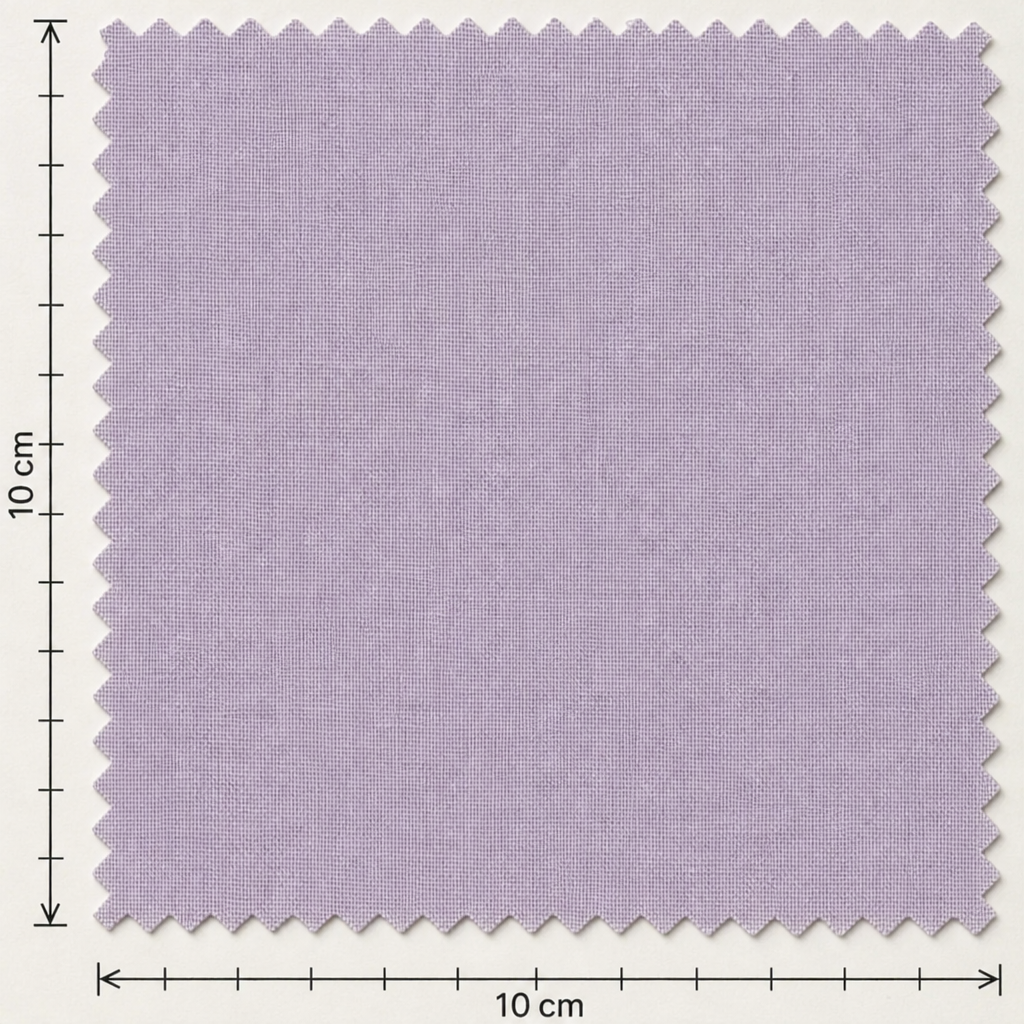
For an internal screening trial, make a measurement sheet before starting. On fabric, record marked distances in both principal directions; on garments, define exact landmarks and whether measurements are flat widths or circumferences. Photograph the setup so another person can repeat it.
For yoga bottoms, consider inseam, outseam, front and back rise, hip width, thigh width, leg opening, and waistband dimensions. For tops, include body length, chest width, hem width, and relevant openings. Choose points that connect directly to the approved fit, rather than collecting measurements nobody will use.
Formal testing should follow the selected method’s preparation, conditioning, marking, and measurement requirements. Do not describe an informal studio wash trial as standards-compliant unless every applicable requirement has been followed. (cdn.standards.iteh.ai)
Calculate and report dimensional change clearly
A useful calculation convention is:
Dimensional change (%) = [(after measurement − before measurement) ÷ before measurement] × 100
Under this convention, negative values indicate shrinkage and positive values indicate growth. For a hypothetical marked distance that changes from 50 cm to 48 cm, the result is −4%.
Report each direction separately. A hypothetical result of −4% lengthwise and +1% widthwise should remain two results, not become an averaged “1.5% shrinkage” claim. The separate values describe different fit consequences.
Include the wash procedure, drying procedure, cycle count, and relevant observations with the numbers. ISO notes that machine type, detergent, and drying parameters can affect results. Without the procedure, a percentage is difficult to interpret or compare. (iso.org)
Assess repeated care, not just the first wash
Agree on checkpoints before testing begins. For an internal development screen, you might inspect after the first wash and again after several additional cycles; these are proposed checkpoints, not universal pass requirements. Use the laboratory method or customer specification when formal compliance is required.
Keep individual specimen results alongside any average. If one sample behaves differently, investigate its identity and processing history before dismissing it. Averages are useful summaries, but your approval decision should also address consistency.
Recovery testing should reflect movement and rest
Stretch and recovery are related but different. Stretch describes extension under specified conditions; residual growth describes the extension remaining after the force or imposed extension is removed and the specimen rests. A material can stretch readily yet retain unwanted growth afterward. (store.astm.org)
For an internal comparative screen, ask the laboratory to establish an appropriate procedure and document:
- The direction tested and starting gauge length.
- The applied force or target extension.
- The duration and number of loading cycles.
- The recovery intervals before remeasurement.
- The laundering history of each specimen.
Do not improvise weights or extension targets and then compare the results with a supplier’s standardized report. Use informal checks to guide development questions, and formal testing to support defined performance claims.
A simple illustration shows the distinction. Suppose a 100 mm gauge length is extended to 130 mm and measures 103 mm after the chosen rest period. Under a starting-length convention, residual growth is 3%; that is not the same number as the proportion of the imposed extension recovered. State the calculation convention whenever reporting a recovery percentage.
For product development, compare unwashed and laundered specimens under the same agreed conditions. Then add a structured garment trial: use the same movement sequence, wear duration, rest interval, and measurement landmarks for each sample. Suggested observations include waistband position, knee bagging, seat shape, seam appearance, and movement restriction.
Treat wear trials as complementary evidence, not a laboratory substitute. Record the wearer’s feedback separately from measured dimensions. This keeps “feels looser” available as useful feedback without confusing it with an established growth result.
Turn test results into a fit-based approval decision
Before requesting a pass or fail, define what acceptable means for the product. Write a development specification that includes the care procedure, measurement points, allowed changes, appearance requirements, and recovery evaluation. Choose tolerances with the pattern maker, supplier, and laboratory rather than borrowing an unrelated garment’s limits.
Translate percentages into actual measurements. In a hypothetical 75 cm inseam, 4% shrinkage represents 3 cm of lost length. Use that calculation during fit review: a percentage that looks modest in a report may still exceed the design’s acceptable length change.
A practical approval record can include:
- Sample identity: Style, size, color, fabric lot, and production stage.
- Test conditions: Method, selected procedure, drying route, and cycle count.
- Measurement results: Starting dimensions, final dimensions, and calculated change.
- Appearance findings: Photographs and notes on seams, twisting, trims, and decoration.
- Decision: Approved, rejected, or approved only after a named corrective action and retest.
Use failures to form specific questions. If fabric screens well but the garment does not, compare construction and component behavior. If different colors produce different results, request their processing records. If laundering dimensions remain acceptable but wear trials show bagging, move the investigation toward stretch recovery rather than increasing pre-shrinking indiscriminately.
For custom orders, retain an approved reference garment and its measurement record. When a fit complaint arrives, ask which dimensions changed and what care routine was used, then compare a retained sample under the documented procedure. This creates a clearer investigation than debating whether the item simply “shrunk.”
Care routines that support the tested fit
For the wearer, the starting point is the complete care label—not the assumption that all cotton can be washed alike. Cotton-care guidance from Persil recommends using the appropriate colder washing conditions and low tumble-drying heat where permitted, while recognizing that some garments require line drying or reshaping and flat drying. (persillaundry.com)
A practical routine is:
- Check washing and drying instructions together. Follow any restrictions for the complete garment.
- Choose the permitted wash conditions. Do not substitute a hotter routine simply because another cotton item tolerates it.
- Remove the garment promptly. Smooth the fabric and align its shape before drying.
- Use the specified drying method. Where flat drying is required, reshape the garment on a suitable surface.
- Avoid unnecessary additional drying. If tumble drying is permitted, follow the stated setting rather than repeatedly extending the cycle. (persillaundry.com)
Cold washing and low heat are precautions, not zero-shrink guarantees: washing, drying, and structural relaxation all matter. Likewise, smoothing damp cotton knitwear back into shape is a care practice, not evidence that every shrunken garment can be permanently restored. (scholars.uky.edu)
If a garment changes unexpectedly, document its dry measurements and contact the maker before attempting aggressive stretching. For custom cotton yoga wear, share the affected area and care history so the maker can distinguish lost length, twisting, and wear-related growth.
Evaluate environmental trade-offs with the same discipline
Mechanical compressive shrinking can operate without added shrink-control chemicals, but that fact alone does not establish the environmental performance of an entire finishing route. The Sanforized process description identifies mechanical treatment alongside moistening and drying steps. Compare complete processes rather than treating “mechanical” as a universal sustainability claim. (sanforized.de)
For supplier discussions, request information about water use, drying energy, finishing inputs, usable yield, and reprocessing. Compare routes that meet the same garment requirements. Otherwise, an apparently simpler treatment may merely shift work to another production stage.
Set a practical goal: achieve the required stability with a documented, repeatable process. Track rejected material and corrective runs alongside treatment inputs. Avoid environmental claims until you have evidence appropriate to the claim’s scope.
Build stable fit into the product
Start with a fabric and finishing route suited to the garment, then verify laundering change and stretch recovery separately. For your next development round, approve a representative finished sample, retain its measurements, and provide care instructions that match the tested routine.
The most useful promise is not “cotton that never changes.” It is a clearly defined fit expectation supported by a repeatable process—and a clear plan for investigating anything that falls outside it.